Manifesto
There is no difference between art and thought.
Art is simply the eminent aspect of thought.
Each lives within the other, and it is perhaps for this reason that I have always wanted to cultivate at the same time these two defining aspects of my being. It may seem strange, but my conduct is very similar to — indeed, it continues — the classic tradition of the nineteenth-century painter who travelled with his album and portrayed all the most interesting moments of his journey. Mine, in the same way, is a rendering of images that unfolds along the path of thought.
One thing in particular unites us, and that is the search for beauty. In the nineteenth century it was entrusted to inspiration: now, in the turbulent sea of modern knowledge, it becomes a search grounded chiefly in meditation. In this sense I consider myself a practitioner of modern art, always founded on the search for beauty, and not a contemporary artist, who is instead more interested in the search for astonishment.
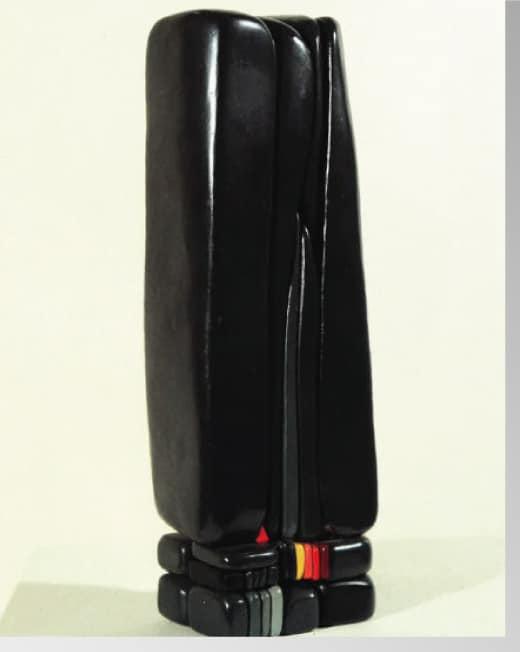
Totem of Thought No. 6, 1989, enamelled wood pulp, 36x12x8 cm
Nevertheless, I do not consider myself out of step with the times: on the contrary, I believe I am very close to contemporary knowledge. I recall a time in my youth when I wondered whether it was more fitting to excel in a single discipline or to be second-best in several. I had no doubts and chose the second option, because excellence, in my view, is achieved only through the completeness of knowledge. For this reason, though I feel driven by a primarily humanistic spirit, I sought to compensate for this imbalance through my scientific studies at the Politecnico. From this arose a confluence that today I can regard as positive. I was able to develop my art fused into the reflections of my thought. I will briefly outline this journey.If in an early, youthful phase, from the age of ten, I approached art as a search for beauty, driven by the inspiration that arises from nature, then after my scientific studies I discovered another kind of beauty, perhaps even more fascinating, in the study of the laws of physics and mathematics. It is the beauty of meditation. The two kinds of beauty, which clearly do not exclude one another, gave rise in me to the conviction that only an integral vision of reality can bring me fulfilment. For this reason I developed the two components in parallel, with the ever more resolute conviction that my art is simply the handwriting of my thought.Indeed, precisely when the two forms of beauty completed and connected with each other, I allowed myself to seek an, if possible, exhaustive solution to the “Why of Whys”. Essentially an epistemic inquiry capable of overcoming the now worn-out and futile dispute between the things of the world and the thoughts of the mind: in fact, between positivism and idealism, between the inductive and deductive paths. This is an evident necessity, if one considers that man is unquestionably made up of two components: matter and spirit. These must of necessity coexist within me as their sole holder.
This conviction led me, at the beginning of the 1970s, to call into question the rigour of science which, on its own, is certainly not fulfilling. I was convinced, and today, at the end of that journey, I am even more so, that science is exact but it is not real. Reality involves both thoughts and things: and yet complete knowledge cannot exclude a third element, namely the word of language, which, though fleeting and as such open to question, constitutes the third component necessary to transmit and amplify knowledge.
In the 1970s I thus began to cast doubt upon, and even to crack, the fundamental concepts of scientific knowledge, illustrating them with paintings and sculptures bearing significant titles such as “Almost straight line”, “Almost cube”, etc.: an affront to analytic geometry and, at the same time, an opening towards more human and therefore more realistic solutions. It was in that period that I drafted my first writing, “The Logic of the Thought”. In it, in search of the melting point between matter and spirit, I discover the importance of the third element, the word, which Wittgenstein had already identified in 1920, but which had never been analysed. Its inner, hermeneutic nature tells us that it is not well defined, as we already supposed: now, however, I have discovered that it has its own quite precise configuration. And it can be represented by a curve known as the Gaussian bell curve, with a vertex at the centre of attention and two branches trailing off towards plus infinity and minus infinity. It turns out to be the minimal entity containing both the material and the spiritual components. The word as an “entity” of thought will be the subject of my most varied artistic interpretations.
Despite the fact that its fleetingness constitutes a further difficulty in our search for truth, in the end the word turns out to be perhaps the most interesting element for an epistemologically more complete vision. In several works of this period one notes the search for coexistence between things and thoughts, conditioned by unpredictable interventions, not always rationally intended, which are represented by a red touch, as though it were an intruding and provocative component.With the second writing, “Absolute Relativity” of the 1980s, the problem seems to grow even more complicated. The word, which joins with other words in forming the usual propositions, multiplies its own indeterminacy by as many times as there are words making up the proposition. It becomes an indeterminacy amplified until, in the end, we find ourselves no longer with the traditional references (three of space and one of time) but with infinite references that are even mirror-like, because in discourse I am a reference for you, but you are one for me. A complication upon a complication. If the situation of my inquiry apparently grows more complicated, in fact the premises are being laid for a new and perhaps unique way of reading our reality.
It is in the 1990s, with the drafting of “The Purification of Thought”, that a solution takes shape which today appears decidedly fulfilling. The inner nature of the word can be depicted by an inductive method, that is, a method that reaches us from physical experience, thanks to the equation of a Gaussian. That same inner nature can also be represented deductively, that is, as a result of scientific thought, by the curve constituted by the “locus of the points tangent to plus infinity and to minus infinity and to a line parallel to the axis of the abscissae…”. Two different ways of interpreting the same curve, one experimental and one theoretical. In practice, the only two possible readings of the constitutive form of the word can be expressed by two equations. Logic tells us that the solution to the problem lies in their coincidence, that is, in a system of the two equations.
I do not wish to set out these steps, and I will therefore come to the conclusion.
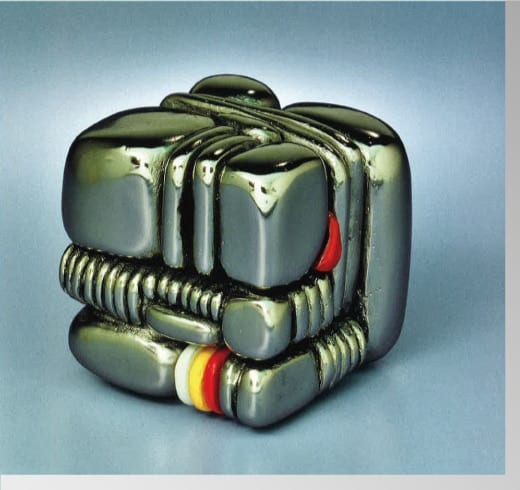
“Almost Cube” 1992, chromed brass with enamelled inserts. Multiple 1/10, 7x7x7 cm
The whole thing turns out to be feasible, even though in the final solution of the path of knowledge there remains an “e” which, as is well known, represents the irrational number par excellence. From such a reading of our perception of the things of the world, we derive the justifying elements and the consequential steps that bring us closer to a religious-fideistic interpretation of existence. This is what is illustrated in the writing “Why Christ – Complex Thought”, published by the Ludes University of Lugano.A path that technically appears flawless arrives in the end at a result that still contains a very small dose of irrationality. And which therefore carries with it a justified suspicion.
Is it ever possible that, despite the consequentiality and logical correctness of the steps, one does not manage to touch epistemic truth?
If this happens, it is perhaps due to the fact that at some point along the path an error was made.
It is in the writing “The Theory of Inequality” (2019, “La Fronda” editions) that this misstep is identified.
To account for it, I erase the entire preceding path, which now seems to me certainly muddled and almost useless, in order to concentrate simply on the “method” of knowing. I start from scratch, that is, I start from man who, alone, immersed in nature, seeks to create his “own knowledge”. He must identify what is common and which laws govern nature, that is, the trees, the leaves, the blades of grass, the stones, the clouds, etc. Is there a law that governs their existence? Yes, there is, and it is very evident: it is the total absence of equalities. Certainly, if I line up three stones I produce a straight line; and if it is then two stones with another two stones, I create a certain result that seems fulfilling. But all these are operations that presuppose an intellectual and intentional intervention on my part and that in the end lead me to what will happen with pure idealism, subsequently validated by science: that is, to a squared-off and rigorous vision of things, which does not, however, respect the very nature of things. It is precisely in this first, primordial step that the choice of the wrong path occurs, which will thus lead us to the present reading of our world, ever more profound and more muddled.
Only in our own day, and in a little-frequented branch of knowledge, is it discovered that inequality lies at the foundation of a more complete, more integral and therefore more human knowledge.
Without knowing it, we are living through the phase of a post-Euclidean knowledge, that is, of a path that is no longer founded, as science has done to this day, solely on the axioms of Euclid and on equalities.
The titles of my current works, of the kind “From chaos to thought”, indicate the will to find an entirely new thought that leaps over the complications and falsities of pure science.
Giuseppe Locati